© Catacombe San Sebastiano 2026
Via Appia Antica 136 Rome 00179 Italy
follow us
The Basilica of Saint Sebastian outside the Walls
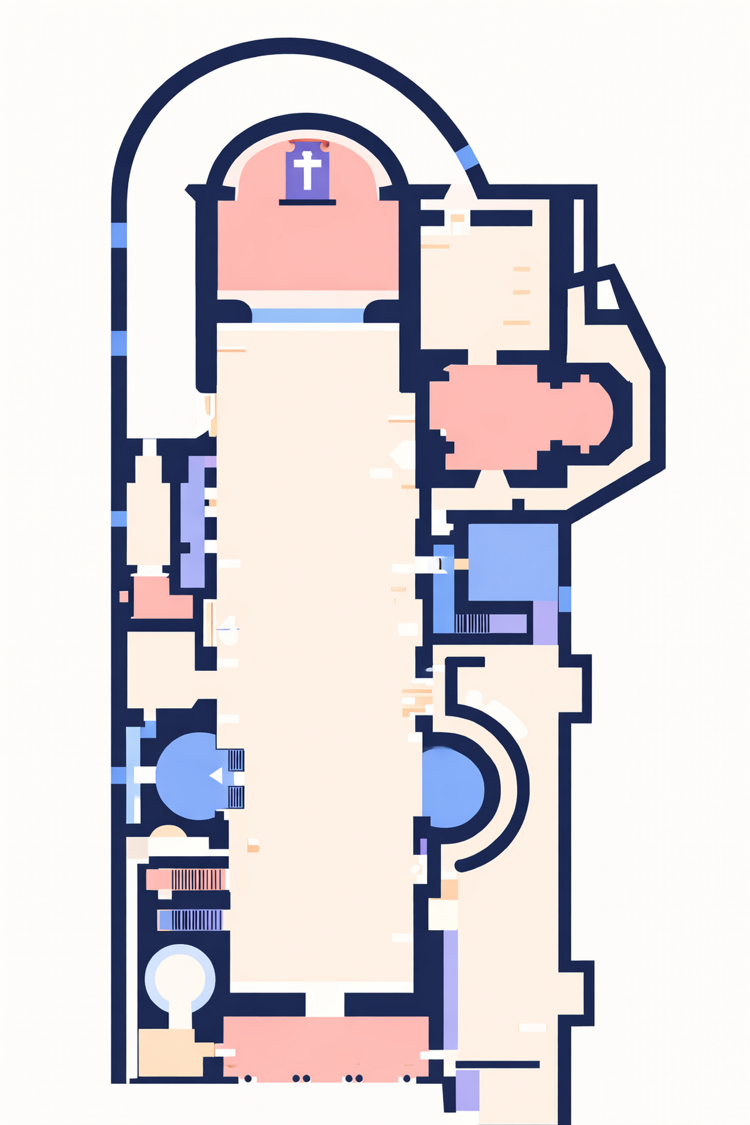
built by occupying the central nave of the ancient Constantinian circiform
You can navigate by clicking on the numbers of the basilica, have a good visit.
According to church tradition, during the persecutions of Valerian in the 3rd century AD, the relics of the Apostles were hidden and venerated here for about fifty years.
The Basilica is located at the 3rd mile of the ancient Appian Way. Originally called the Basilica Apostolorum, it was built at the behest of Emperor Constantine in the 4th century AD in honor of the Apostles Peter and Paul.
Over time, veneration of Saint Sebastian, a soldier-martyr during the time of Diocletian, buried in the catacomb, prevailed over the name of the cemetery and the basilica.
The basilica has undergone several restorations. During the most significant, from 1608 to 1613, Cardinal Scipione Borghese undertook a complete renovation of the basilica and crypt of Saint Sebastian, based on the design of Flaminio Ponzio and under the artistic direction of Guido Reni. The restoration was completed by Giovanni Vasanzio while the facade, designed by Ponzio, dates back to 1612.
.jpeg)
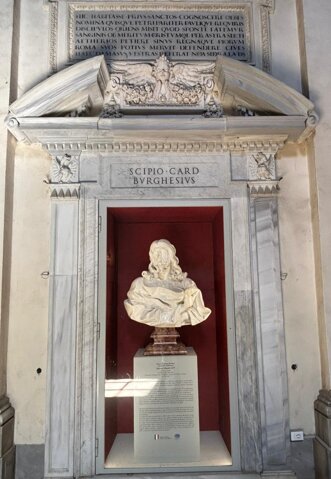
1- Altobello d'Ense Tomb
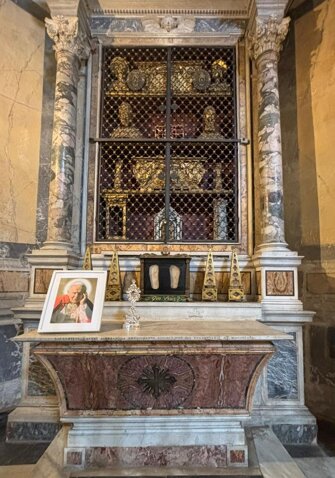
3- Chapel of Relics
2- Salvator Mundi
In the niche: The "Salvator Mundi" by Gian Lorenzo Bernini, 1679 see page.
Above: "Saint Bridget and Catherine of Sweden visiting the catacombs of Saint Sebastian", canvas by an unknown artist.
Reminds of the visit of the two saints to the apostolic tomb.
Below: On the wall is bricked up the reproduction of the lost tombstone erected in the IV century by Pope Damasus, bearing an iscription in honor of the apostles Peter and Paul, this reads: You who go looking for the names of Peter and Paul You must know that the saints lived here in the past. These apostles were sent to us from the East, we readily acknowledge; but by virtue of their martyrdom (following Christ up through the stars they reached the heavenly regions and the kingdom of the righteous) Rome had the privilege of claiming them as its citizens. This is what Damasus wanted to say in your praise, o new stars.
Commissioned by Maximilian I, Duke of Bavaria, 1625.
According to tradition it contains: thorns from the Crown; a finger, a tooth, and part of a rib of St. Peter; a tooth of St. Paul; a bone and an arm of St. Andrew; part of the head and an arm of St. Fabiano; the skulls of Popes Saint Callisto and Stephen; a lead chalice with ashes and bones of Saint Fabiano; an arm of Saint Roch; part of the skulls of Saints Nereus and Achilleus, of Saints Avenisto, Valentino and Lucina, Martyrs; a relic of St. John Paul II.
In the center: the arrow of martyrdom and part of the column of the martyrdom of Saint Sebastian and the stone of the "Domine Quo Vadis?".
Leaning against the wall: Funeral monument of Altobello d'Ense da Montecorvino, unknown artist.
The doctor, who died in 1615 and was very active during epidemics, wished to be buried in San Sebastiano, because of hes devotion to the Saint ad hes traditional role as a protector against the plague.
5- Altar of St. Francesca Romana
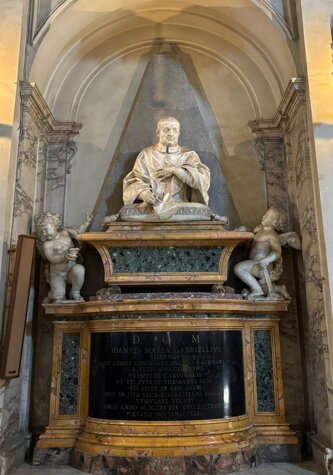
4- Funeral monument of Cardinal Gabrielli
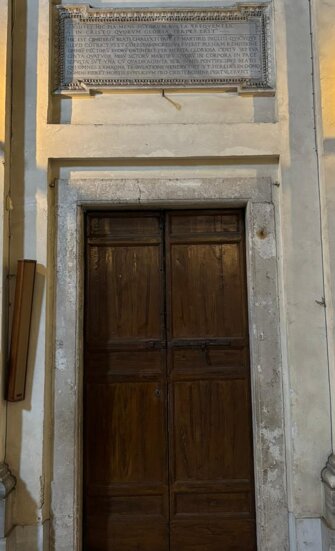
6- Original entrance to the Catacombs
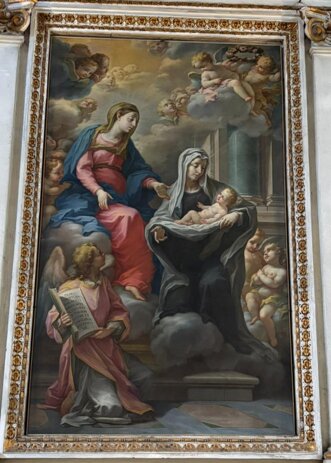
Above the altar: "S. Francesca Romana, Vision of the Virgin and Child" by Filippo Frigiotti, 1727
Against the wall: the Funeral Monument of Cardinal Giambattista Francesco Maria Gabrielli, member of the Cistercian order and administrator of the funds of the Albani chapel, the author and date of which are unknown; the work comes from the church of San Bernardo alle Terme.
The bust of the deceased rests on a white marble cushion, flanked by two little angels.
Above: Inscription at the entrance to the “Callisto cemetery”. Until the 14th century it was common to call the cemetery under the Basilica of San Sebastiano with the name of San Callisto. The original Callisto cemetery was rediscovered only in 1849.
Inside: "God the Father and Saints" by Antonio Carracci.
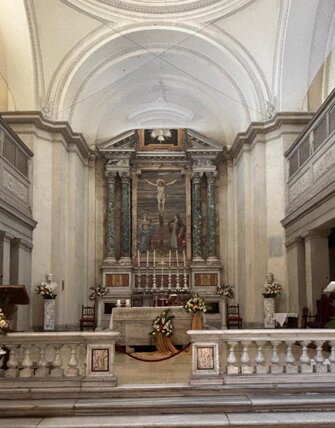
9- Main Altar
8- Chapel of Pope Saint Fabian
7- Altar of Saint Girolamo
Designed by Flaminio Ponzio.
Above the altar: fresco depicting "The Crucifixion" by Innocenzo Tacconi, 1614.
On either side: busts of St. Peter and St. Paul by Nicolas Cordier, 1608.
Table, Main Altar: sarcophagus from the 5th century AD; on the sides the Arrest of Peter and the Resurrection of Lazarus, in the centre Christ between Saints Peter and Paul.
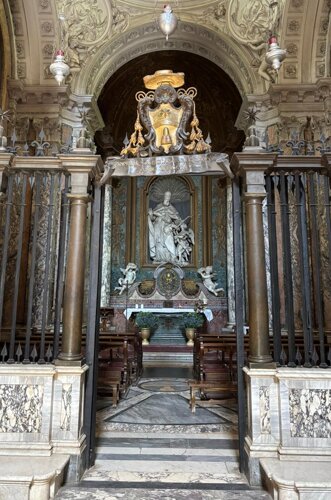
Built by Clement XI (Albani family) between 1706 and 1712 based on a design by Carlo Fontana, assisted by Alessandro Specchi and Filippo Barigioni.
Above the altar: statue of St. Fabiano by Pietro Papaleo, 1710-12.
Right wall: canvas "S. Fabian Consecrating Emperor Philip" by Giuseppe Passeri.
Left wall: canvas depicting the "Election of St. Fabiano" by Pier Leone Ghezzi.
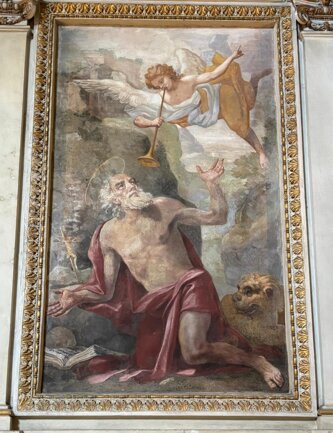
Above the Altar: "Saint Jerome and the angel playing the trumpet of Judgment" , canvas by Archita Ricci, 1613.
.jpeg)
.jpeg)
12- Altar of Saint Carlo Borromeo
11- Altar of Saint Francis
10- Entrance to the Epigraph Museum
Above the altar: "Saint Charles Borromeo in adoration of the Sacred Nail", fresco by Archita Ricci, 1613-14.
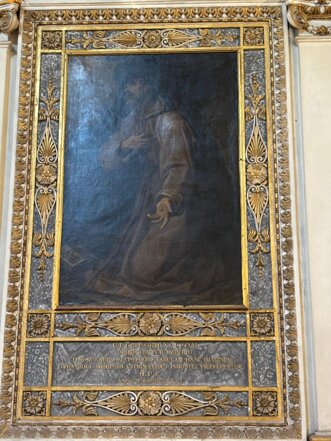
Above the Altar: "S. Francis in Prayer" canvas by Girolamo Muziano, 18th century. XVI.
The Epigraphic museum, now closed to the public. Called at the time “Museum of sacred and Profane Art”, it was opened on January 20, 1930, thanks to the contribution of the Friars Minor and in particular of Fr. Damiano Pinna, to restore the archaeological complex of Saint Sebastian to its rightfull place as a masterpiece of Roman civilization; inside are preserved inscriptions and sarcophagi found in the archaeological complex, between the 2nd century AD and the 5th century AD.
.jpeg)
.jpeg)
13- Chapel of the Crucifix
15- Left side entrance
14- Chapel of Saint Sebastian
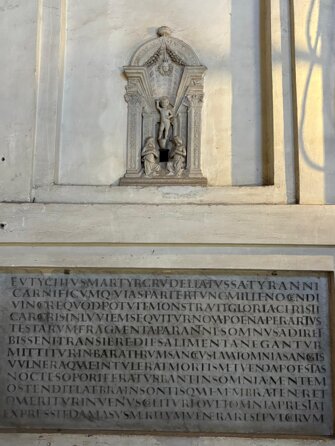
Above: tabernacle of Mino da Fiesole, XV century. Used for chrism oils.
Below: a poem dedicated by Pope Damasus to the martyr Eutychius, reading:
Eutychius, martyr who conquered the cruel order of the tyrant As wel as the thousand torments inflicted by the executioners, testified to the glory of Christ.
The bleak prison was followed by new bodily trials; fragments of pottery prevent him from sleeping: twelve days went by: He is deprived of food; He is cast into an abyss, the holy blood cleanses all the wounds inflicted by the tremendous power of death.
At night during sleep is mind is troubled by dreams; He indicates the place were his Holy body is concealed. It is searched for and once discovered venerated; He protects us And grants us all favours.
Damasus has expuonded his merits, you worship at his tomb.
Ancient sacristy: from the Borghese restorations of the early 17th century, the frescoes are by Marco Tullio Montagna
Left wall: “The Virgin with Saints Sebastian and Lucina” 1627.
On the vault: "God the Father and the Saints" by Marco Tullio Montagna 1627.
Right wall: “S. Sebastian prepares for martyrdom”, canvas by Pietro Sigismondi, 1618.
In the center: a wooden crucifix by an unknown artist from the Lazio school. A 14th-century work.
Commissioned by Cardinal Francesco Barberini in 1672, it was designed by Ciro Ferri; the statue of St. Sebastian was made by Giuseppe Giorgetti (a pupil of Bernini) based on a design by Ferri. The altar houses the relics of the Saint; the plaque reads: Saint Sebastian, Soldier and Martyr of Christ, defender of the Church, defeated the plague.
.jpeg)
17 - Crypt of Saint Sebastian
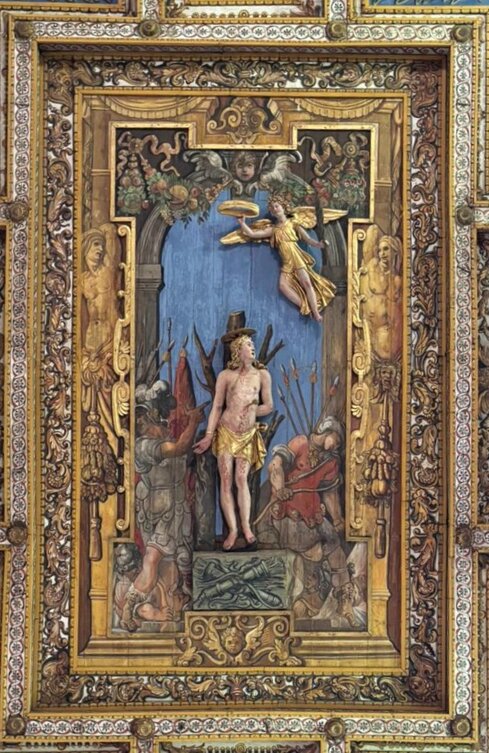
16 - Wooden ceiling
The church boasts a notable carved wooden ceiling made by Annibale Durante based on a design traditionally attributed to Giovanni Vasanzio, 1612.
In the center Is the Martyrdom of Saint Sebastian, tied to a tree and pierced by arrows.
At the end towards the main altar is the 19th-century coat of arms of Pope Gregory XVI.
At the entrance the coat of arms of Cardinal Scipione Borghese.
The crypt is a 17th-century work, commissioned by cardinal Scipione Borghese. It was an adaptation of some cubicles of the catacomb, where Saint Sebastian was buried at the beginning of the 3rd century.
It can only be visited by entering the catacomb on a guided tour.